
The 2018 Scottish Household Survey had a very significant change to its questionnaire from the previous year. It no longer asks if each member of the household is either Male or Female.

It now asks ‘How would you describe your gender identity?’ The possible options being (1) Man/Boy (2) Woman/Girl (3) In another way and Refused.

(This change to the Household Survery has no doubt paved the way for the upcoming proposed changes to the Census 2021 Bill currently making its way through parliament. The Census Bill claims that the Census question on Sex is actually a question about Gender Identity, and proposes that it be amended to include a third, non-binary option.)
The point of the Scottish Household Survey is to understand the issues and performance across the country by being able to analyse across key demographic household characteristics such as deprivation, age, income, sex, rurality, ethnicity and other equalities.
This also ties in with the Fairer Scotland Duty and the Public Sector Equality Duties which are based on the protected characteristics as stated within the Equality Act 2010.
( Reminder: Sex is the Protected Characteristic – not Gender – not Gender Identity. )
In addition to this public bodies must meet their obligations under the Human Rights Act which makes it is unlawful for public bodies in Scotland to act incompatibly with the Convention rights.
The important, and relevant one here is the Convention on the Elimination of All Forms of Discrimination against Women (CEDAW).
This dramatic change in data collection then raises some important questions …
- How can equalities in Scotland be monitored if Sex is no longer recorded?
- Why is the Scottish Government now prioritising gender identity over sex?
- Who did they consult when they were deciding to make this momentous change by deviating away from existing equality legislation?
Publicly available email exchanges between a number of the stakeholders involved might be able to provide some answers to these questions.

It would appear that the Sex question has been changed from the standard binary Male or Female answer to be inclusive of people who do not identify as either male or female, as they instead identify their gender as being non-binary. The decision to do this appears to have made with the full expectation that the current ongoing review of the Gender Recognition Act 2004 will result with the introduction of legal recognition for non-binary people. [UPDATE: the Scottish Government announced on 20/6/19 they have no plans to introduce legal gender recognition for people who identify as non-binary]
The National Records of Scotland (NRS) expressed concerns about the proposed change of wording to the question, and stated that stakeholder feedback was to maintain the sex binary responses Male or Female, rather than the proposed options of Man or Woman.

Having responsibility for the Scottish Census 2021, the NRS stated
“Ideally the Census question will be identical to the core questions … so while (Scottish Government) prefer the wording you have proposed … it is not yet clear that this will be the census question.”
[UPDATE: The Census 2021 sex question will remain ‘What is your Sex? Female or Male’]
The Equality and Human Rights Commission warned of the negative impact this might have on data collection.

They also highlighted that it wouldn’t be able to provide any statistics at all regarding the people who have the protected characteristic of gender reassignment.
So who have they changed the wording of the question for? It would appear to been for the sole benefit of the group of people who identify as non-binary. Yet non-binary isn’t even a protected characteristic within the Equality Act 2010, and therefore isn’t an equalities monitoring requirement for public bodies. This drastic change will not only wipe out any reliable and accurate data collection of the protected characteristic Sex, it also does nothing to assist with the improvement of collecting data about the group of people who have the protected characteristic Gender Reassignment.
Has this question really been amended just to ‘get ahead of the legislation’? This Household survey consultation was circulated amongst stakeholders way back in early 2017, many, many months before the consultation on the Review of the Gender Recognition Act had even opened!
Who exactly were the stakeholders that were consulted and then supported this change?
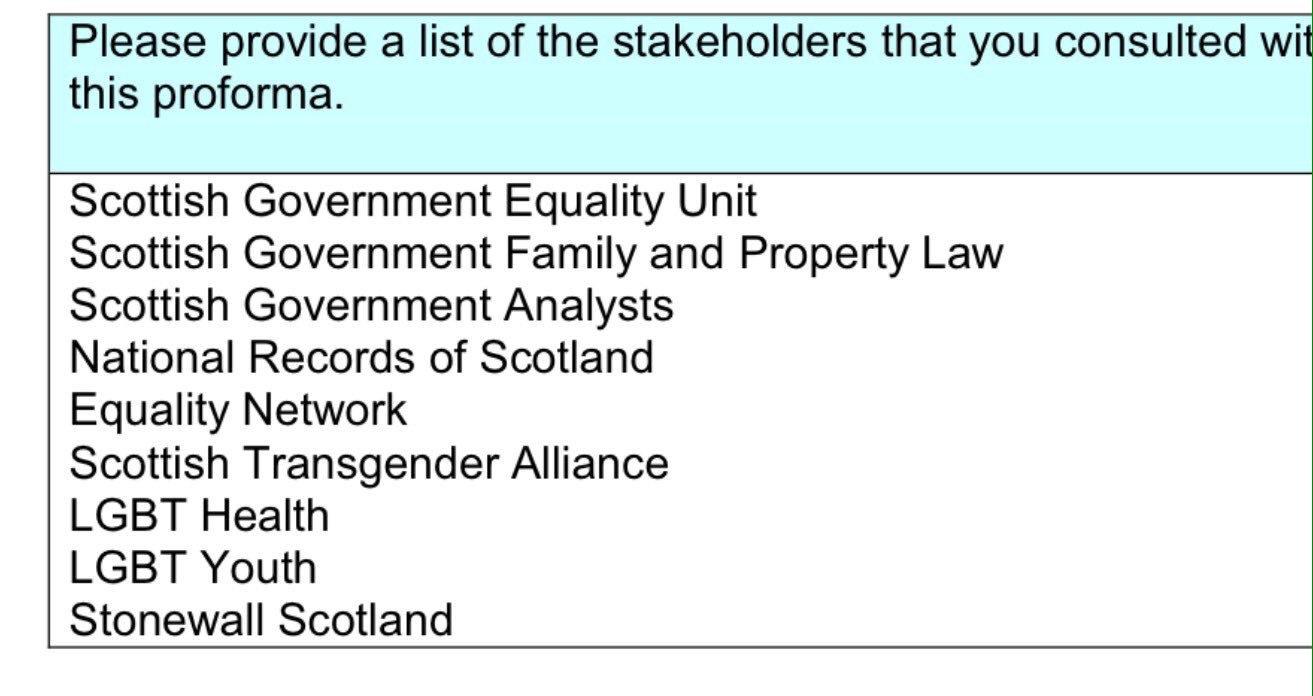
No women or feminist groups then? There certainly appears to be no shortage of LGBT or Trans groups being consulted.
Here are the comments from Scottish Transgender Alliance:

Oh the irony!
“… it is in everyone’s interests to have more accurate demographic information with which to make policy decisions.”
Scottish Transgender Alliance
Does it not seem strange that Scottish Transgender Alliance weren’t making proposals to collect data on the group of people who identify as transgender? This new Household Survey question will make zero improvements for that group.
Here is the stakeholders co-ordinated response by Equality Network:
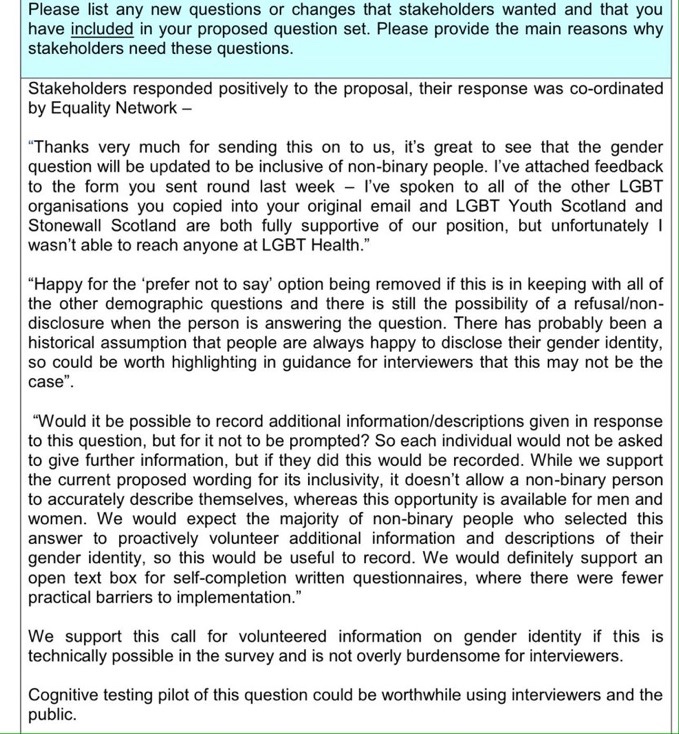
When National Records of Scotland had suggested the preferred options were Male or Female and for the harmonisation of questions across the UK to be maintained, the response received clarified that the 2011 Census question asked about Sex, therefore Male or Female was the appropriate response.
Also, that they had ‘proposed the term ‘gender identity’ to further differentiate the social from the biological’. It is not known why they would want to shift data collection away from the biological, or what they think would be the benefits of doing so.
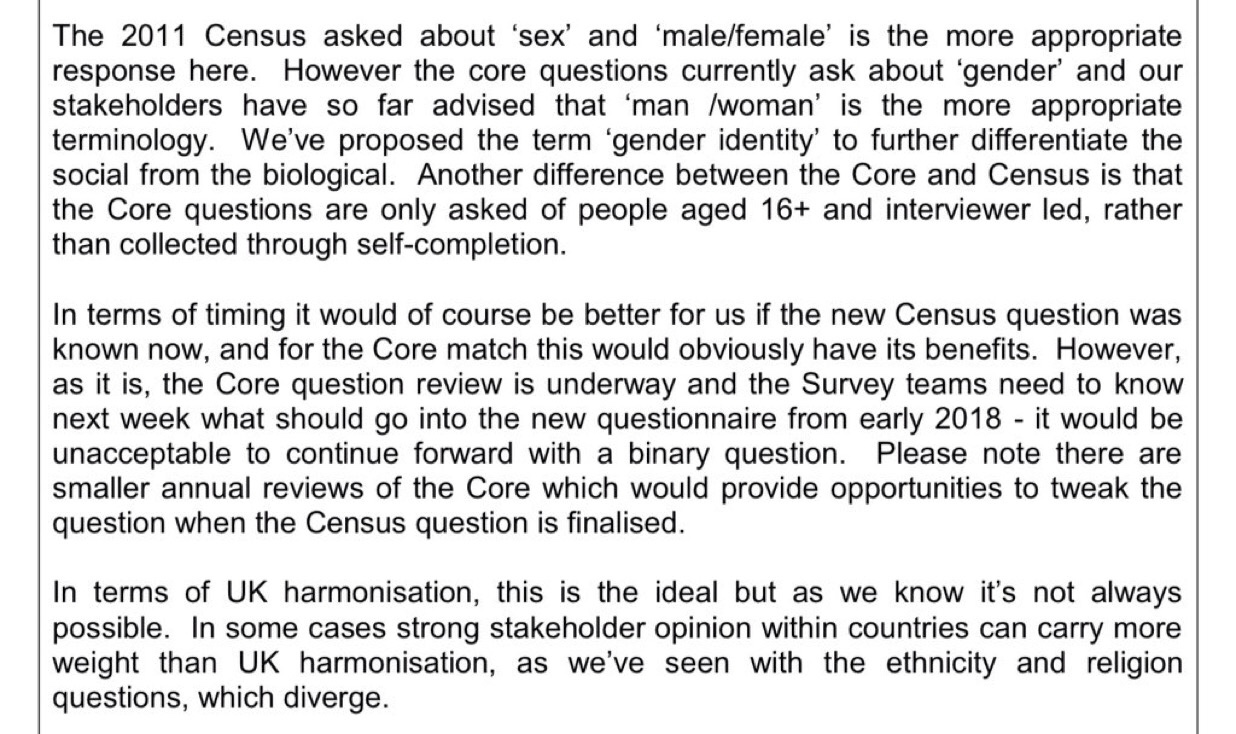
It is also unknown why it would ‘be unacceptable to continue forward with a binary question’? This decision appears to have been made after consultation with a very small select group of stakeholders, whose specialised agenda may not fully align with the wider population. Also, why is there a great rush to get this through?
The Equality and Human Rights Commission had asked why they wanted to use ‘Gender’ instead of ‘Sex’, and use ‘Man or Woman’ instead of ‘Male or Female’ – and the response was that they use gender identity to differentiate between the social and the biological – so they do know there’s a difference between Sex and Gender!
The question then is, why is it the priority of the Scottish Government, in their push for gender equality, to focus on the social, rather than on sex, the biological?
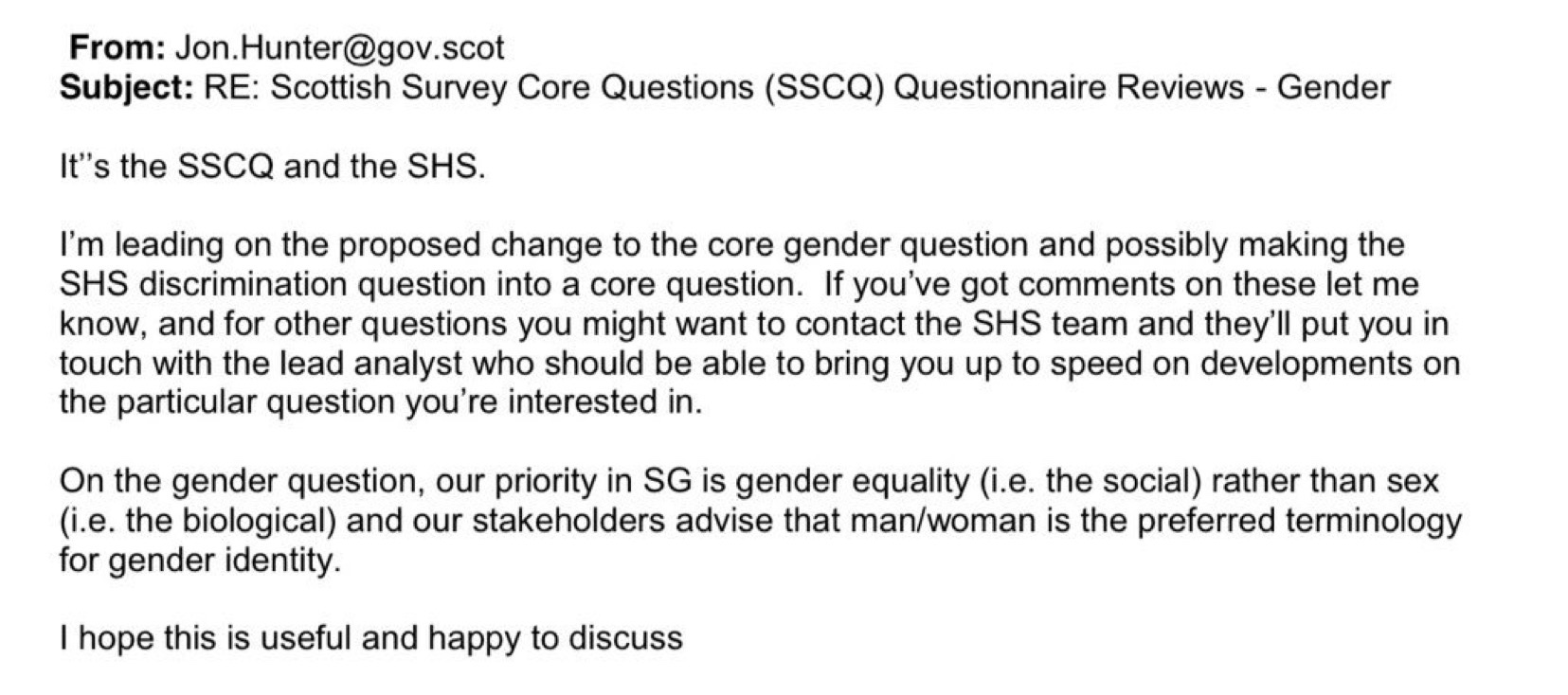
There are copious amounts of evidence available to support the fact that women and girls suffer great inequalities across every aspect of their lives on the basis of them being female.
How will the inequalities that women experience ever cease if our society, and government prioritise damaging gender stereotypes and social roles over the reality of biological sex?
[UPDATED 10/09/19: The results of the 2018 Scottish Household Survey are now available]
Update: on 24/5/21 the Chief Statistician wrote to the Office for Statistics Regulation requesting:
the OSR to do a compliance check on the arrangements we have in place for collecting and reporting gender identity on this survey. Ideally this would cover the work done around the introduction of this question. This would help provide assurance to me, users of this data and survey participants that this has been well handled.
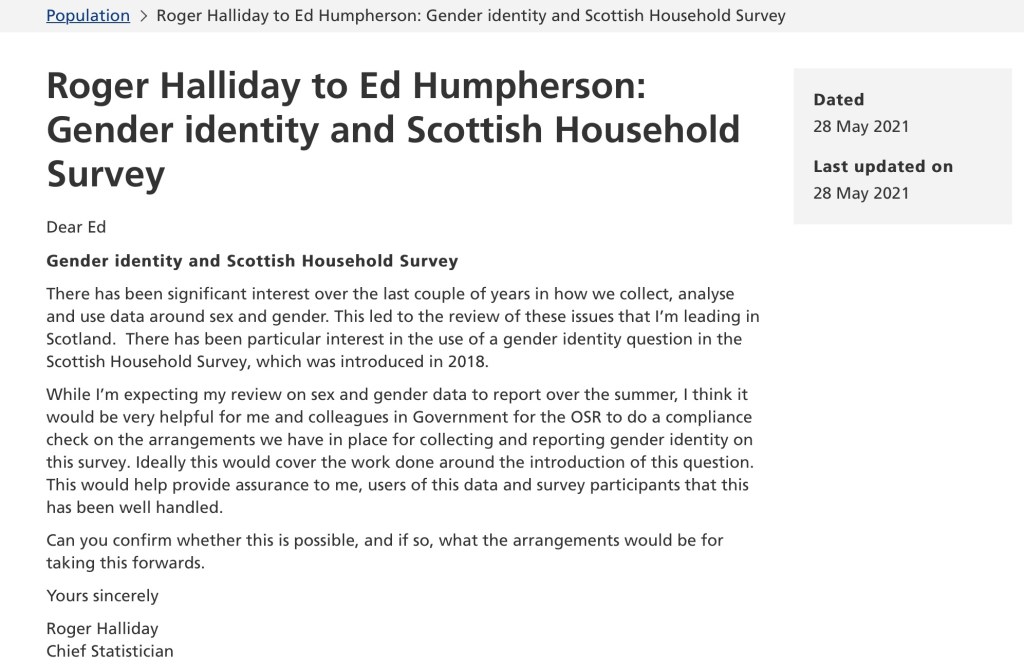
On 28/5/21 Ed Humpherson, Director General for Regulation wrote back
I’m pleased to receive your request for this review of the Scottish Household Survey against the standards of the Code of Practice for Statistics with regard this matter, and I hope any findings or outcomes can feed into your wider review on sex and gender data in Scotland..
My team will take forward this work in the coming weeks and will be in touch with statisticians involved in the Scottish Household Survey shortly to agree arrangements.

It was then confirmed by the Chief Statistician that questions for 2022 were being finalised. This was in response to a question from the Non-Binary working group in October 2021 who were asking about data collection of people who identify as non-binary.
How long is the implementation process?
teams are finalising questions currently for 2022 and would need a full year of data and we do not have the ability to change the questions mid 2022 but would look at 2023 for the publication of results. We may have access to the data from smaller surveys sooner
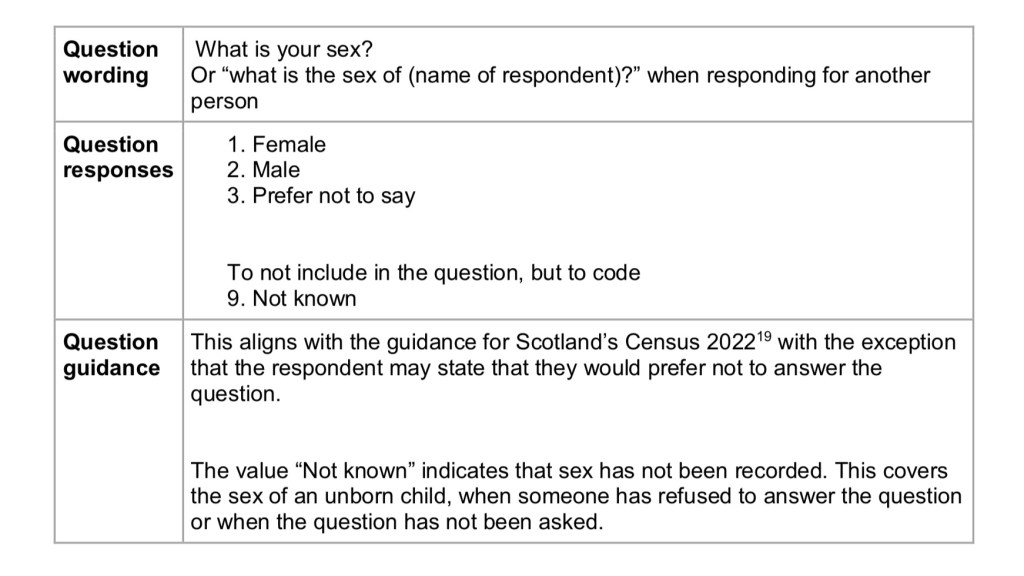
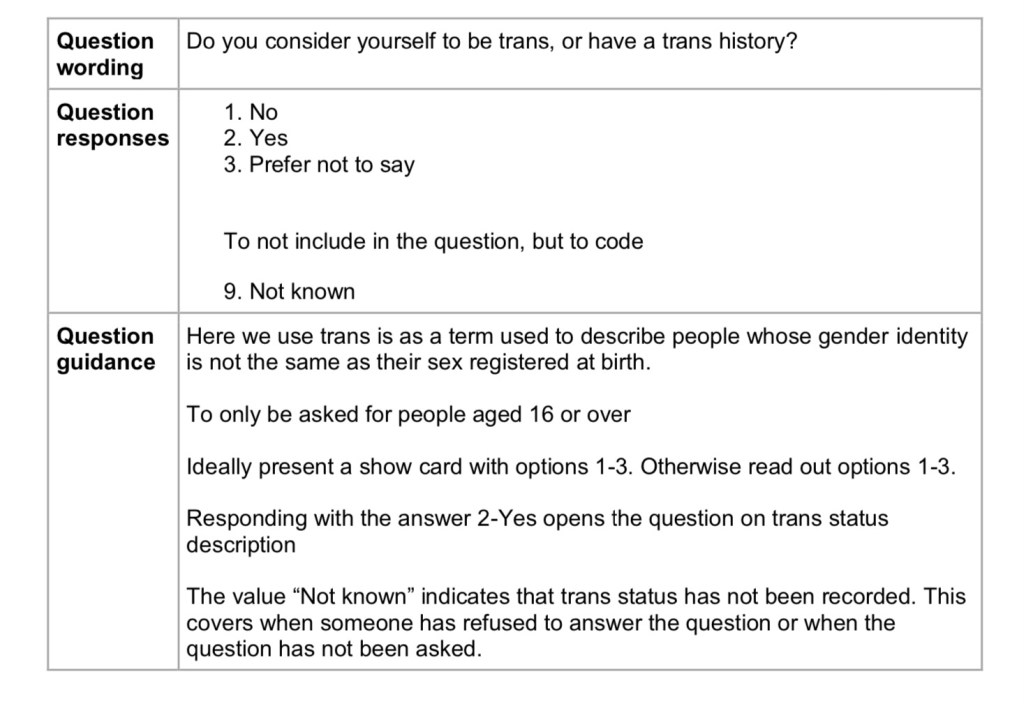
New Data collection and publication guidance: Sex, Gender Identity, Trans Status had recently been published in September 2021.
It confirmed questions on sex would be: What is your sex? Response: Female, Male, Prefer not to say.
It also included guidance on a trans question: Do you consider yourself to be trans or have a trans history? Response: No, Yes, Prefer not to say
Minutes of the Non-Binary working group also revealed:
Reassuring the Group that the Chief Statistician, is open to the view that the sex question may require a third open ended option but evidence is required that this is something which is needed and that the existing set of questions is unsuitable for a non-binary person.
Office of the chief statistician also noted that they would welcome being provided with more evidence on why a non-binary question is needed and that additional support from the group when they approach public bodies to embed the guidance would also be appreciated if this was something the group was able to be involved in.
The Group highlighted that members are engaging in this work voluntary basis and that they believe that a lot of this would should have been carried out by the Sex and gender in data working group as part of their original approach, going on to note the Group’s belief that bon-binary people’s existence should be enough evidence to show that a non-binary question is needed.
The Household Survey questions were changed for 2018, and it looked to be leading the way for the reforming of the Census questions too. Now it seems the organisations responsible for collecting data are complying with the Code of Practice and other regulations, and the 2022 questions are now to ask about Sex, and not Gender Identity.
Success
Follow me on Twitter SusanSinclair@Scottish_Women
 Scottish Women