
LGBT groups are simultaneously lobbying the UK Government to change the protected characteristics and scrap single sex provisions within the Equality Act 2010 AND being funded by the Scottish Government to develop guidance and deliver training to policy makers, organisations and service providers.
Can anyone see that there might be some conflict here? We already know that no Equality Impact Assessments were performed for a number of these new guidelines and policies. Is there anyone at the Scottish Government overseeing the legalities of these training packages and guidelines?
Who is looking out for women and girls?
Scottish Transgender Alliance
Below are screenshots that detail some of their Government funded activities.

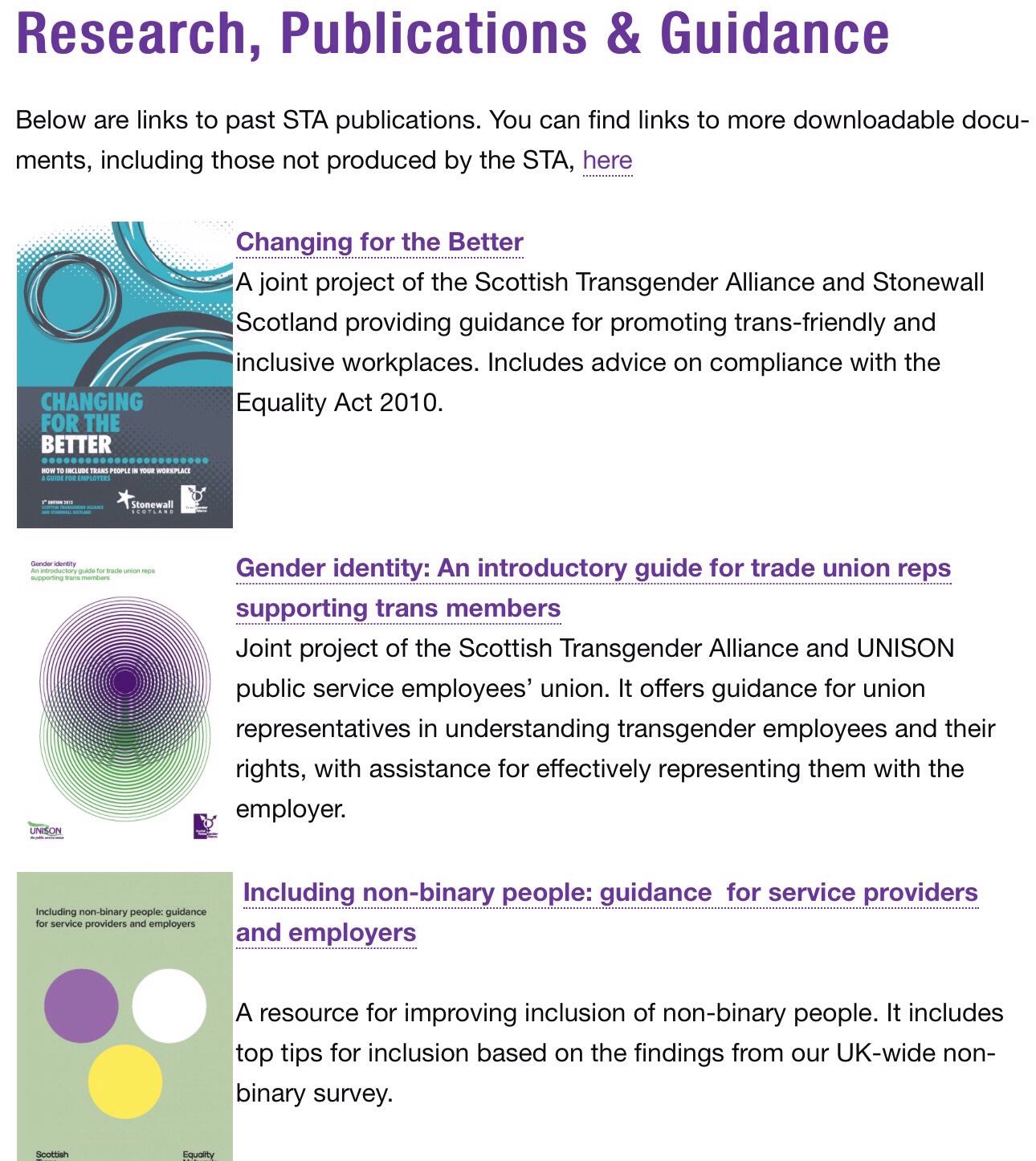
“A core component of the remit of Scottish Trans Alliance is to provide high quality training to public service providers in Scotland, to help mainstream transgender equality, rights and inclusion. To date, Scottish Trans Alliance has provided a wide range of training on good practice in relation to transgender employment and service provision issues to the following Scottish public services:”
Yet, there is an obvious equalities conflict here as the UK Women & Equalities Committee Transgender Equality Inquiry received a written submission from Scottish Trans Alliance and Equality Network with a request that single sex exemptions within the Equality Act 2010 be removed.
The Equality Act 2010 should be amended to:
o Include gender identity as a protected characteristic
o Remove the exception that allows single sex services to discriminate against trans people
o Remove the genuine occupational requirement (GOR) allowing some jobs to require applicants must be cisgender and replace it with a GOR allowing posts delivering trans-specific services to require applicants must be transgender
Scottish Transgender Alliance
Scottish Transgender Alliance were the authors of the Scottish Prison Service Policy which states:
A male-to-female person in custody living permanently as a woman without genital surgery should be allocated to a female establishment. She should not be automatically regarded as posing a high sexual offence risk to other people in custody.
Scottish Prison Service
Is this really in line with the Equality Act 2010?
Stonewall Scotland
Similarly, Stonewall Scotland also work with organisations, Local Authorities, Schools etc providing training and guidance.
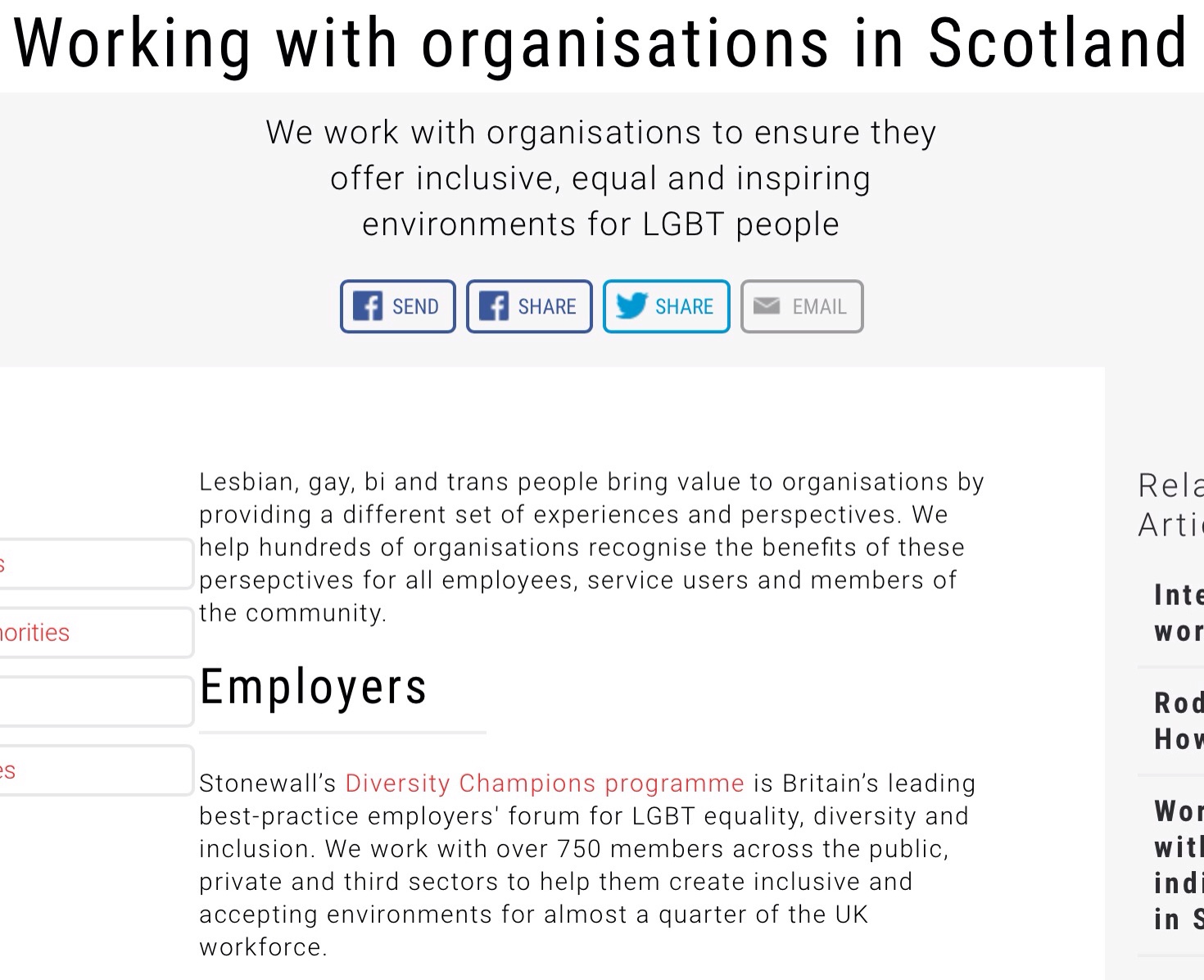
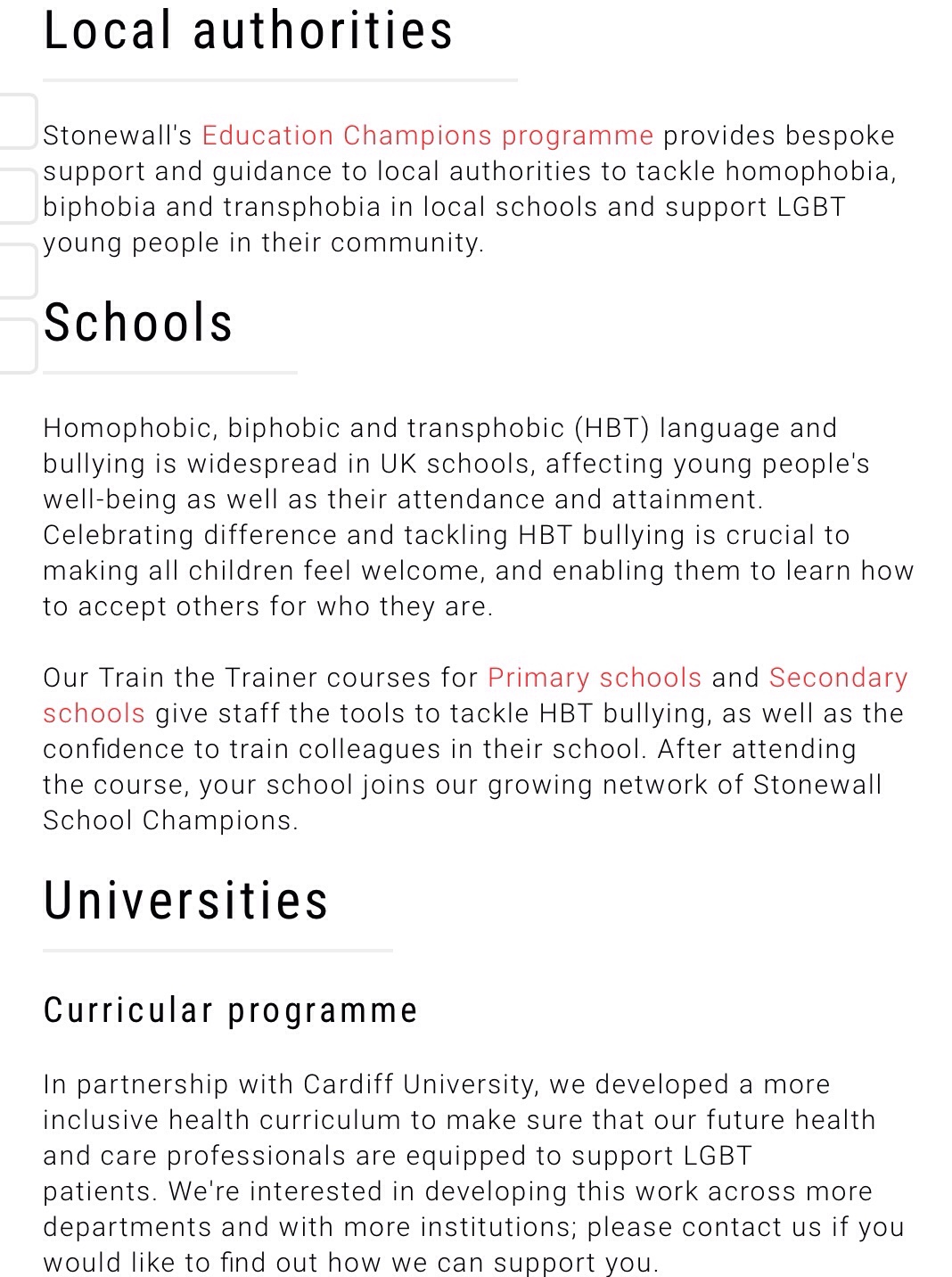
The UK Women & Equalities Committee Transgender Equality Inquiry also received a written submission from Stonewall.
The effectiveness of the Equality Act 2010
19. Stonewall is aware that ‘gender reassignment’ as defined in the Equality Act can be understood to cover a broad range of trans identities. However, because the current definition places an emphasis on a process of transition, it is unclear whether all trans people are protected.
20. The schools and employers that Stonewall works with understand the term ‘gender reassignment’ in different ways. Many are unaware that trans people who do not take medical steps to transition are protected. They are also uncertain about whether people who do not describe their identity in terms of a transition, are protected. Stonewall is particularly concerned that the definition does not explicitly provide protection for non-binary people.
21. Stonewall is deeply concerned that exemptions within the Act actively remove protections for trans people. Schedule 3, Part 7, permits service providers to deny ‘transsexual’ people access to separate or single-sex spaces. Exemptions in Schedule 9 in the area of occupational requirements allows employers to have a requirement for employees ‘not to be a transsexual person’, including in the Armed Forces. In addition, Part 14 permits differential treatment in ‘gender-affected sport’.
22. Stonewall also believes that these exemptions sit in contention with the Gender Recognition Act as they imply that being a ‘transsexual person’ supersedes a person’s legal gender.
23. Stonewall believes that amending the protected characteristic ‘gender reassignment’ to ‘gender identity’, and ensuring that this is defined to cover a broad range of trans identities, would send a clear signal to trans employees and service users, public bodies and employers, that all trans people are protected by The Act.
This is Stonewall saying that they believe it is wrong for the Equality Act to deny trans people access to single-sex spaces or gender-affected sport because they are the opposite sex, as in their view biological sex shouldn’t ‘supersede’ legal gender.
LGBT Youth Scotland

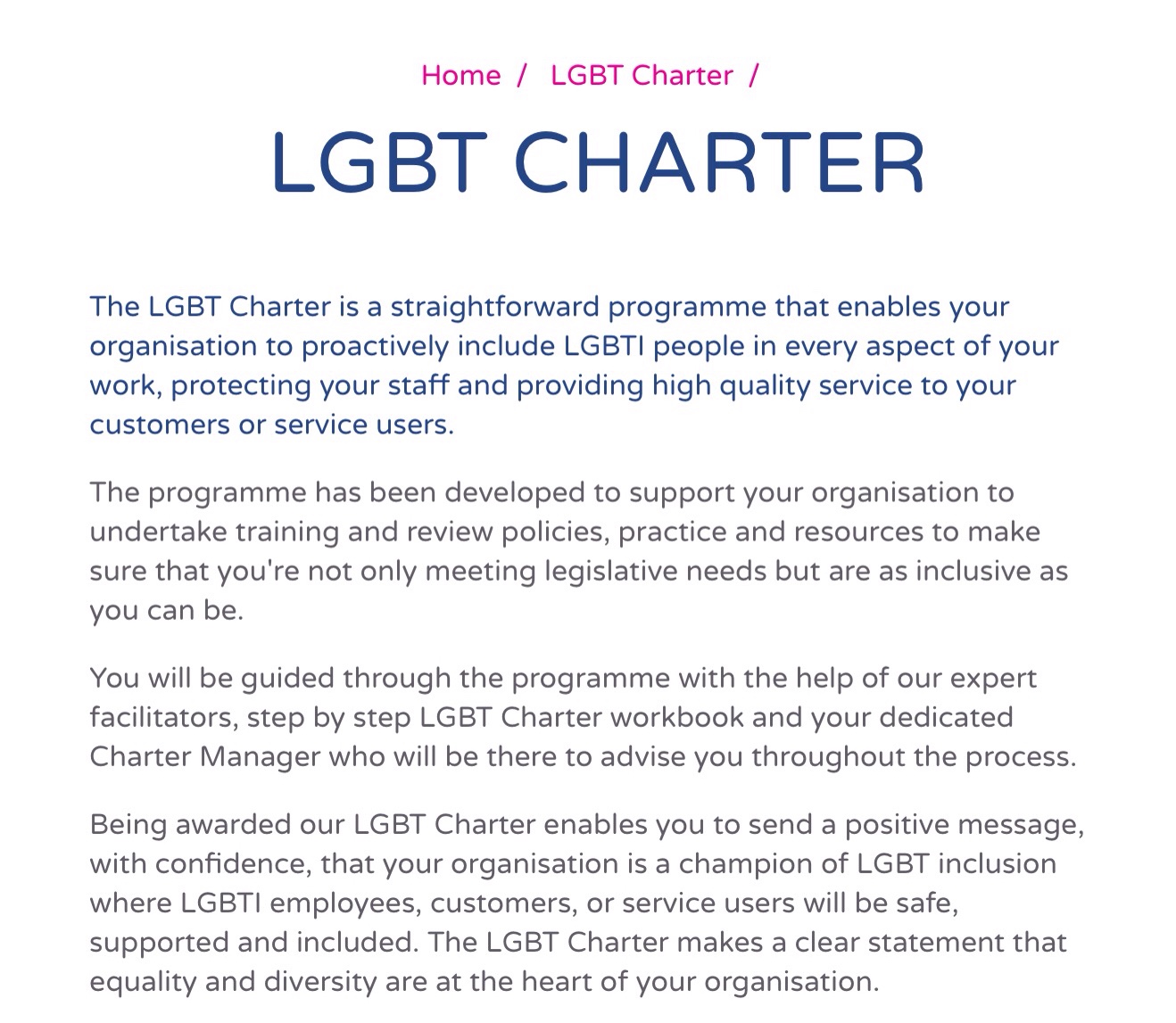
LGBT Youth Scotland also submitted evidence to the Women & Equalities Committee requesting a much broader interpretation of the protected characteristic Gender Reassignment.
We recommend expanding the protected characteristic of gender reassignment to include gender identity and expression so that non-binary identities and cross-dressers are clearly covered.
LGBT Youth Scotland
School Guidance created by LGBT Youth Scotland has been issued to all schools across Scotland, yet not one single authority carried out any Equality Impact Assessments for it. This school guidance, co-written by Scottish Transgender Alliance (who want to scrap single-sex provisions), contains Good Practice Tips for schools to permit transgender youths to use the single-sex facilities and communal accommodation of their preferred gender rather than their sex.
Does anyone think this Good Practice is in line with the Equality Act 2010?
No one apparently checked.
Local Authorities in Scotland
Below are examples of Local Authorites who have been incorrectly ‘trained and advised’ about the protections within the Equality Act 2010.

Stonewall Scotland, the leading campaigning organisation for lesbian, gay, bi-sexual and transgender (LGBT) people, recommends that the term ‘gender’ is used rather than ‘sex’ as it is more inclusive.
East Lothian Council
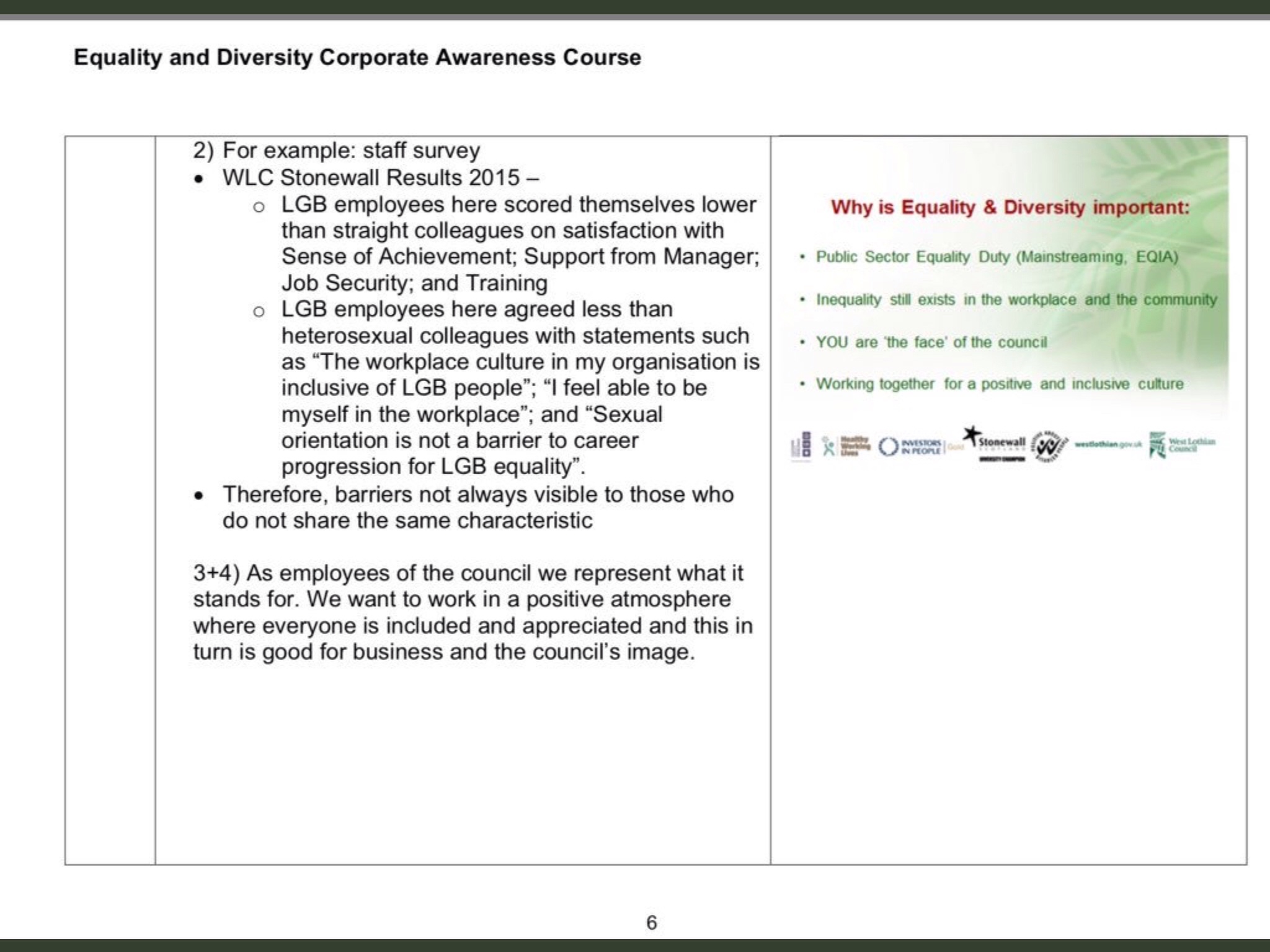
These are extracts from West Lothian Council’s Equality and Diversity Corporate Awareness Course. The Stonewall logo is right there on the slide, right below the incorrect list of Protected Characteristics that fails to mention ‘Sex’, and has also wrongly included one for ‘Gender Identity’.

It is utterly incredible that training on the Public Sector Equality Duty fails to correctly name the nine protected characteristics as detailed within the Equality Act 2010. That’s its entire point!
Further evidence submitted to the Women & Equalities Committee
We would like to see the protected characteristic be gender identity as defined in the Yogyakarta Principles, so it is clear they are fully inclusive. In terms of case law, there is a lot of fear about being a test case. It is incredibly emotionally demanding. You would be scrutinised by the press; your identity may well end up mocked. You do not have a guarantee that there would be reporting restrictions; you might be lucky and get those, but you are not certain to. We have been trying to persuade people to take forward test cases, but people are very nervous of doing so, and we cannot make someone give up years of their life to that process.
The guidance could be stronger and better, but really without moving to a protected characteristic of gender identity there are still these loopholes. There are also non‑binary people who decide, for various personal reasons, “I am not going to change the gender in which I live. I am going to continue living in my birth gender, but I might want to share with others that my gender identity is not as simple as that.” However, the act of sharing that information could lead to discrimination, and, because they are not proposing any part of a process of moving away from their gender assigned at birth, they would not have protection. The perception coverage would only be if they were perceived as transsexual, and if they have come out as non‑binary, they are being perceived as non‑binary, not as transsexual. So even if you had some case law, there would still be these gaps, and that is why we think that the protected characteristic needs to change.
James Morton, Manager, Scottish Transgender Alliance Oral evidence
James, just moving the discussion on a little, in terms of the way that the Act works, your organisation argues for removing the expectation that allows single‑sex services to discriminate against trans people.
Would you include in that women’s refuges?
Committee Chair
It is really important to recognise that just because somebody might need slightly different provision or might have some additional complexities about being included in a service, that should not be reason for not trying to include them or for treating them worse. The exception, as currently drawn, effectively has no limit. You could be decades transitioned, you could be fully integrated and you could still be turned away at your moment of need from a refuge or from a rape crisis service.
It boils down to whether or not you really see trans women as women. If you see a trans woman as a woman, then, just like a very butch lesbian woman or a woman with a severe mental illness or a Muslim woman in a burqa might be perceived as difficult to integrate or might receive a negative reaction from other service users, you would not turn them away. You would work to educate, you would work to support and you would work to try to make sure that that service could be accessed by them, and that is really important.
It is also important that we recognise that this is a small number of people, it is not going to overwhelm a service. There are services, such as rape crisis services and women’s refuges, that are trans‑inclusive successfully and have not found it impossible to do. They have done it very successfully, so why can others not? It needs to be looked at and, yes, there might be some situations and very limited situations where you might have to treat someone differently, but they should not be treated worse.
James Morton, Manager, Scottish Transgender Alliance Oral evidence
The Equality Act 2010 permits schools, prisons, hospitals and other single sex groups like Girlguiding to exclude transgender people, this is especially true where women and girls would need their right to privacy and dignity respected for example if they are undressing or using shared accommodation. The legislation acknowledges that women only spaces are needed and that any decision to permit a male transgender person access must be balanced with the needs of those women and girls using those services and any possible detriment to them.
It is extremely worrying that factually incorrect equalities training and guidance is being delivered in exactly the same manner that those groups had lobbied for.
The Scottish Government needs to urgently review all of the training guidelines and policies to ensure they are compliant with the Equality Act 2010. It is not enough for them to say these are not Government issued guidelines when the lobby groups who have created them were given funding from the Government to do just that.
Follow me on Twitter SusanSinclair@Scottish_Women
Follow me on Facebook “Scottish Women”
I have 5 Campaign Aims and rectifying the legalities of policies is one of them.
If you like the work that I do, and believe it is a worthy cause then please consider offering your support by either making a one-off donation using a credit or debit card, or alternatively by setting up a monthly donation via PayPal, click here to donate
Thank you for all your support, Susan Sinclair
 Scottish Women